HVAC Troubleshooting: Why Your System is Blowing Warm Air
Vents blowing hot? Use these home maintenance tips and troubleshooting steps to safely diagnose the failure point. See exactly when to call a professional.



Understanding how undersized systems fail to keep you comfortable is the first step toward solving a problem that affects more than half of all U.S. homes. If your air conditioner runs constantly but your Sacramento home still feels hot and sticky, or certain rooms never seem to cool down no matter what you set the thermostat to, there is a good chance your HVAC system simply does not have enough capacity to do its job.
Here is a quick summary of how undersized systems fail:
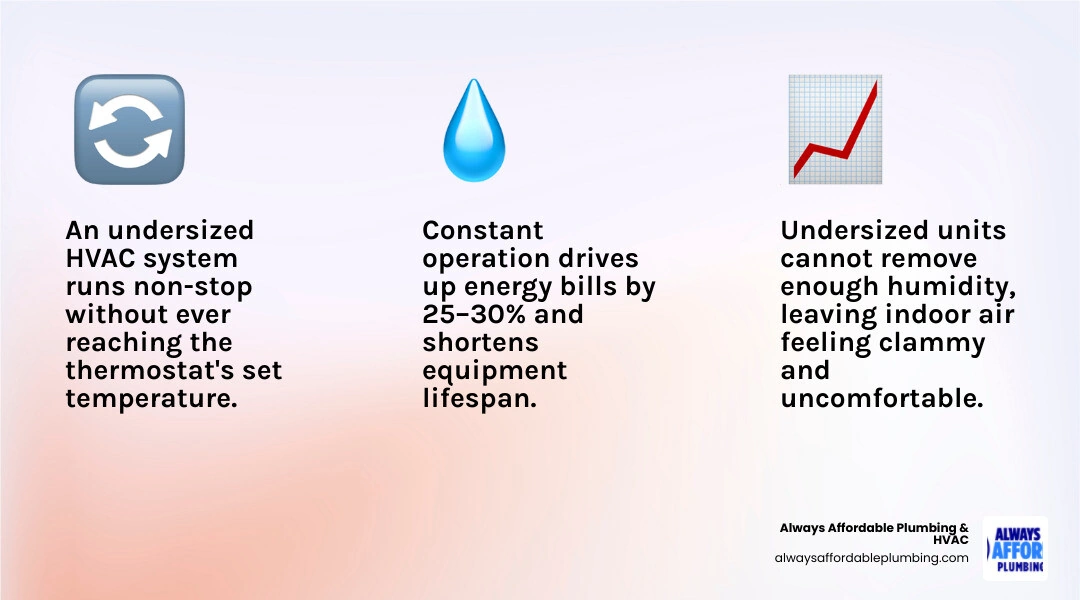
• They run non-stop without ever reaching your thermostat's set temperature
• They can't remove enough humidity, leaving indoor air feeling clammy and uncomfortable
• They create uneven temperatures, with some rooms staying noticeably warmer than others
• They drive up energy bills by operating at full load for hours on end
• They wear out faster, often failing years ahead of a properly sized system
Over 60% of residential HVAC systems are incorrectly sized, and the consequences go well beyond discomfort. Constant operation puts extreme stress on key components like the compressor and blower motor, shortens equipment lifespan, and can push utility bills up by 25–30% compared to a properly matched system. In Sacramento's hot summers, where outdoor temperatures regularly push systems to their limits, an undersized unit is not just frustrating — it is a serious problem that compounds over time.
This guide walks you through exactly what happens inside an undersized system, how to recognize the warning signs in your own home, and what steps you can take to fix it for good.
How undersized systems fail to keep you comfortable vocab to learn:
• getting the right size hvac for the sacramento area homes
• how hvac load calculations work
• how proper hvac sizing affects comfort and efficiency
When an air conditioning system is too small for the home it is trying to cool, it is placed in a permanent state of struggle. Unlike a properly sized system that cycles on and off to maintain a steady temperature, an undersized system has to run continuously. You might notice that during a blistering July afternoon in Roseville or Citrus Heights, your thermostat is set to 72°F, but the actual indoor temperature refuses to budge below 78°F.
This continuous operation is the most obvious indicator of a capacity deficit. Because the system cannot keep pace with the heat entering your home, it never satisfies the thermostat. This leads to persistent warm spots, uneven temperatures throughout your living spaces, and a home that never truly feels relaxing.
To understand why this happens, it helps to look at the two distinct types of heat your AC must remove: sensible heat (which you can measure on a thermometer) and latent heat (the moisture in the air). To explore how proper system capacity impacts your daily living conditions, read more about How Proper HVAC Sizing Affects Comfort and Efficiency.
Here are the most common signs that your system is undersized:
• The system runs continuously for 18 to 24 hours a day during hot weather.
• The indoor air feels consistently damp, sticky, or clammy.
• There is a noticeable temperature difference of 5°F to 10°F between rooms or floors.
• The thermostat never reaches its setpoint during the hottest parts of the day.
• Your monthly utility bills are unusually high despite the home not feeling cool.
An air conditioner is not just a cooling machine; it is also a dehumidifier. As warm, humid air passes over the cold evaporator coil, moisture condenses on the coil's surface and drains away. This process addresses the "latent load" of your home.
However, when a system is undersized, its ability to manage this latent load breaks down. While you might think a system running non-stop would remove more humidity, the reality is that the volume of hot, humid air moving through the home overwhelms the small coil. The air is pushed through too quickly, or the indoor heat load is so high that the system cannot drop the coil temperature low enough to reach the dew point effectively.
The result? Clammy, sticky air that makes 75°F feel like 80°F. High indoor humidity levels (above 50–60%) also compromise your indoor air quality. It creates a breeding ground for dust mites, mildew, and mold growth. Furthermore, because the system is constantly running at full capacity, the evaporator coil is highly susceptible to coil icing. When the coil freezes over, airflow is completely blocked, which can lead to total system failure and warm air blowing out of your vents.
Sensible load refers to the actual temperature of the air in your home. An undersized system fails to meet this load evenly, resulting in dramatic temperature swings from room to room. This is especially true in multi-story homes, houses with vaulted ceilings, or rooms with significant solar exposure.
In places like Elk Grove or Folsom, homes with west-facing windows absorb massive amounts of radiant heat in the late afternoon. A properly sized system has the airflow and cooling capacity to distribute conditioned air evenly to counteract this localized heat gain. An undersized system, however, will dump what little cool air it produces into the rooms closest to the indoor unit, leaving upstairs bedrooms or rooms with large windows feeling like saunas.
If you are dealing with hot upstairs rooms or vaulted living spaces that refuse to cool down, you can find tailored local solutions in our guide on Getting the Right Size HVAC for the Sacramento Area Homes.
To understand why a system is too small, we have to look at how heating and cooling capacity is measured. HVAC capacity is rated in BTUs (British Thermal Units) and tons:
• BTU (British Thermal Unit): The amount of heat required to raise the temperature of one pound of water by one degree Fahrenheit.
• Ton of Cooling: Equal to 12,000 BTUs per hour. This term comes from the amount of heat required to melt one ton of ice over a 24-hour period.
When an HVAC professional sizes a system, they must perform a room-by-room Manual J load calculation. This is the industry-standard methodology established by the Air Conditioning Contractors of America (ACCA). A Manual J calculation does not just look at square footage; it accounts for:
1. The local climate and outdoor design temperatures in the Sacramento valley.
2. The orientation of the home (which direction the windows face).
3. Insulation levels in the attic, walls, and floors.
4. The type, framing, and glazing of all windows and doors.
5. Ceiling heights and overall home volume.
6. The number of occupants and heat-producing appliances.
• 12,000 BTU — Cooling Tonnage: 1.0 Ton — Approximate Recommended Square Footage: 450 – 550 sq. ft.
• 18,000 BTU — Cooling Tonnage: 1.5 Tons — Approximate Recommended Square Footage: 700 – 900 sq. ft.
• 24,000 BTU — Cooling Tonnage: 2.0 Tons — Approximate Recommended Square Footage: 1,000 – 1,200 sq. ft.
• 36,000 BTU — Cooling Tonnage: 3.0 Tons — Approximate Recommended Square Footage: 1,500 – 1,800 sq. ft.
• 48,000 BTU — Cooling Tonnage: 4.0 Tons — Approximate Recommended Square Footage: 2,000 – 2,400 sq. ft.
• 60,000 BTU — Cooling Tonnage: 5.0 Tons — Approximate Recommended Square Footage: 2,500 – 3,000 sq. ft.
Note: This table is for general illustrative purposes. Actual sizing must always be determined by a professional load calculation, as a poorly insulated home with high ceilings will require a significantly larger capacity than a modern, highly efficient home of the same square footage.
Many older systems were installed using outdated "rules of thumb," such as allocating 1 ton of cooling for every 500 or 600 square feet of living space. Relying on these simple square-footage estimates is a major reason why over 60% of homes end up with improperly sized equipment.
If a contractor uses a rule of thumb, they completely ignore the home's unique thermal envelope. For example, a beautifully preserved pre-war bungalow in Midtown Sacramento with plaster walls and original single-pane windows has a vastly different thermal load than a newly constructed, tightly sealed home in West Sacramento with radiant barrier decking and double-pane low-E windows.
To size a system correctly, an experienced technician must follow the complete ACCA design process:
• Manual J: Calculates the exact heat gain and heat loss of the structure.
• Manual S: Guides the selection of equipment that matches those calculated loads under local climate conditions.
• Manual D: Ensures the ductwork is designed to handle the required airflow (CFM) without creating excessive static pressure.
• Manual T: Directs the correct placement of supply registers and return grilles to prevent drafts and stagnant air.
An HVAC system is designed to operate in balanced cycles. A typical, correctly sized air conditioner should run for about 30 to 40 minutes per hour during peak summer days, allowing the system to rest and cool down between cycles.
When an undersized system runs continuously for 18 to 24 hours a day, it undergoes severe mechanical stress. The compressor — the very heart of your air conditioner — is cooled by the cold refrigerant returning from the indoor coil. When the system is overworked and running constantly under extreme heat loads, the compressor can easily overheat. This thermal stress breaks down the compressor's internal lubricating oil, leading to mechanical friction, valve damage, and eventual compressor failure.
Similarly, blower motors and outdoor fan motors are forced to run far past their intended duty cycles. Constant operation leads to motor burnout, electrical shorts, and worn bearings. A properly installed and sized cooling system should easily last 15 to 20 years. However, the relentless strain of an undersized system can cut that lifespan in half, causing complete system failure in as little as 5 to 8 years.
To learn more about how improper sizing destroys expensive components, read our detailed breakdown on How Improperly Sized Systems Shorten Equipment Life.
There is a common misconception that a smaller HVAC system will use less energy because it has a smaller motor. In reality, an undersized system burns more energy, not less.
Let's look at a real-world comparison. Imagine a 500-square-foot living space.
• A properly sized 12,000 BTU (1-ton) system runs for a total of 8 hours spread throughout a hot summer day. It consumes approximately 1,200 kWh of electricity over the cooling season.
• An undersized 8,000 BTU system in that same space must run non-stop for 18 to 24 hours to try and meet the load. Because it never rests, it consumes roughly 1,750 kWh annually to cool the exact same area.
This continuous operation can drive your monthly utility bills up by 25% to 30%. Over a ten-year span, running an undersized system can easily cost you over $1,000 more in wasted electricity alone — completely wiping out any initial savings from purchasing a smaller unit. Even if the system has a high SEER2 (Seasonal Energy Efficiency Ratio) rating, those efficiency ratings are calculated based on normal cycling. Once a system is forced into continuous, full-load operation, its real-world efficiency plummets.
Sometimes, a home exhibits all the classic signs of an undersized system — continuous running, warm spots, high utility bills — but the physical heating and cooling units are actually sized correctly. In these cases, hidden system and building defects are mimicking an undersized system.
The most common culprit is leaky ductwork. According to the U.S. Department of Energy, the average home loses 20% to 30% of its conditioned air through cracks, loose connections, and unsealed joints in the ductwork before it ever reaches the living spaces. If your ducts are located in a blistering 130°F Sacramento attic, duct temperature gain can easily cut your system's effective cooling capacity in half. A perfectly sized 4-ton system can perform like a struggling 2-ton system simply because it is cooling the attic instead of your home.
Other hidden factors include:
• Poor Attic or Wall Insulation: If your home's insulation has settled or is missing, heat will pour into your living spaces faster than a correctly sized AC can remove it.
• High Total External Static Pressure (TESP): If your ductwork is undersized or poorly designed, it restricts airflow. This restriction starves the system of air, preventing it from transferring heat effectively.
• Airflow Imbalances: Closed interior doors without transfer grilles or return pathways can create pressure imbalances that force conditioned air out of the home and draw hot outdoor air in.
If you suspect your system is struggling due to duct issues or poor airflow, scheduling professional HVAC Maintenance Sacramento CA is the best way to diagnose and resolve these hidden efficiency killers.
Even a perfectly sized, high-end HVAC system will begin to behave like an undersized unit if routine maintenance is neglected.
A heavily clogged air filter restricts airflow across the evaporator coil. This restriction reduces the system's heat-transfer capability, causing the system to run much longer to cool the home. Similarly, a dirty outdoor condenser coil coated in dust, pollen, and debris cannot release heat efficiently, forcing the compressor to work harder and run longer.
Furthermore, an incorrect refrigerant charge (either too high or too low) can reduce your system's capacity and increase energy consumption by 5% to 20%. To keep your system running at peak capacity, it is important to know How Often Should You Service Your HVAC and understand why Is an HVAC Maintenance Plan Worth It to prevent these common performance drops.
The most reliable sign is continuous operation. If your air conditioner runs non-stop on a typical 95°F Sacramento summer day without ever reaching your thermostat setpoint, it is likely undersized. Other indicators include uneven temperatures between rooms (up to a 10°F difference), high indoor humidity, and high energy bills despite a lack of indoor comfort.
Yes, absolutely. Because an undersized system struggles to manage latent loads, indoor humidity levels often remain above 50% to 60%. This excess moisture creates an ideal environment for mold growth, mildew, and dust mite infestations. These biological contaminants can trigger allergies, asthma, and other respiratory issues for your family.
The only accurate method is a professional Manual J load calculation. A qualified HVAC technician will assess your home's square footage, wall construction, insulation depth, window types, local climate design temperatures, and sun exposure to determine the exact BTU capacity your home requires. Avoid any contractor who tries to size your system based solely on square footage or by matching the size of your old unit.
An undersized HVAC system is a recipe for ongoing frustration, high utility bills, and premature equipment failure. When a system lacks the physical capacity to meet your home's heating and cooling loads, it is forced to run continuously, overworking vital components and leaving your living spaces warm, damp, and uncomfortable.
Fortunately, you do not have to live with a system that fails to keep you comfortable. At Always Affordable Plumbing & HVAC, we specialize in helping homeowners throughout Sacramento, Roseville, Elk Grove, and surrounding areas find the perfect balance of comfort and efficiency. Our licensed technicians do not rely on lazy rules of thumb. We perform detailed, professional home evaluations, thorough ductwork assessments, and precise load calculations to ensure your heating and cooling systems are sized perfectly for your home's unique thermal footprint.
If you are tired of dealing with hot spots, sticky air, and soaring energy bills, we are here to help. Contact us today to schedule a professional system evaluation or explore our dependable Always Affordable Plumbing HVAC services to restore true comfort to your Sacramento area home.
See what our satisfied customers have to say about their experience with Always Affordable
Plumbing & HVAC.

"Chappy was very skilled in his knowledge of my HVAC unit. I greatly appreciate the quick response and experienced tech. The whole endeavor was made less stressful by his humor and honest conversation. I find comfort in knowing I now have a shop i trust for the next time."
"Tony, James, Ronnie did an amazing job setting up our new AC! They were quick, efficient, considerate, and polite! We appreciate them scheduling us in on such short notice. Definitely recommend this company!"
"Prompt, professional service with kindness and care. They came out to address both plumbing and AC issues. I received a courtesy call before they arrived. All issues were resolved the same day with integrity and respect. Thankful for businesses like this. Absolutely recommend to those that I love."
"Excellent service! Jason came out promptly and in addition to doing my outside faucet he also put in new irrigation equipment! All done perfectly! Jason was lovely"
"Honest with the assessment; friendly and good manners. No high pressure sales. Just good to honest "tell it like you see it" Thought my kitchen disposer needed an overhaul. But Jason, there Plumber gave me an honest lesson on what was really happening. Saved me hundreds, if I went the route of replacing. Thank you!"
"Absolutely 5 stars. If you are looking for affordable ,professional and kind. Chappy was excellent and very knowledgeable . I called in the morning because my air conditioner stopped working he was here within hours and fixed my air with a smile. I highly recommend Chappy and Always Affordable plumbing and Hvac."
"Scott and James were great. They got there quickly and diagnosed the problem with my A/C.They did a very thorough job testing everything. Sent me pictures and called to keep me informed. Got it done the next day and everything is working fine. Be glad when I get home so I can enjoy my new system. Thanks guys for a great job."
"Chappy was very helpful. He knew our issue right away, cleaned our coils. He also came on the same day we called and got our AC blowing cold air again."
"After some timing ’curfuffles’ the Tech Jason arrived and not only completed a speedy install on my toilet, he was personable & professional. Because of the timing issues Jason was attentive and showed up with everything needed! No extra store runs 😊 I was very comfortable with having this Tech in my Daughter’s home. We will definitely use this Service again."