Home Maintenance Tips and Troubleshooting: What to Do When Your AC Blows Warm Air
AC blowing warm air? Review essential home maintenance tips and troubleshooting to spot simple airflow issues. Decide with confidence when to call a pro.



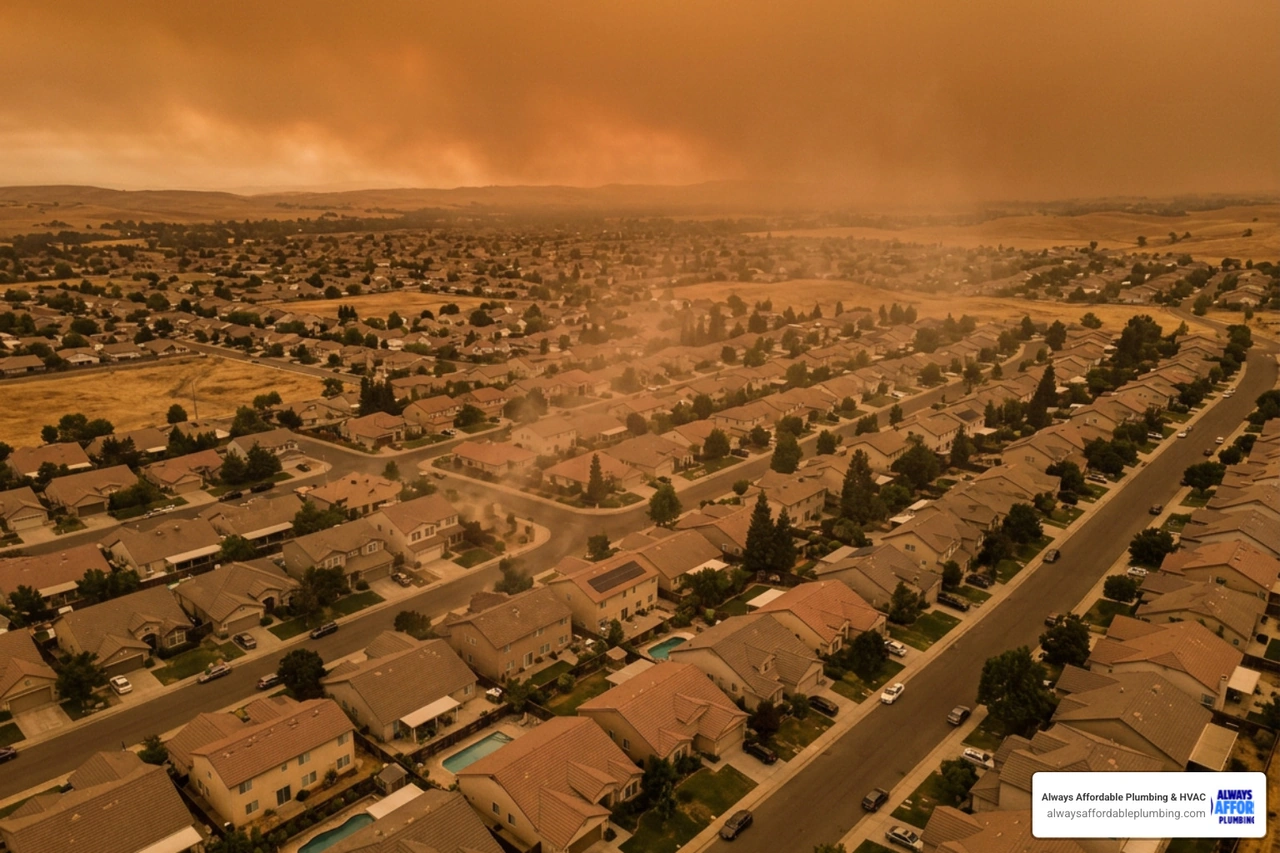
How Sacramento Valley heat and wildfire smoke affect your home is one of the most pressing concerns for local homeowners right now. Each summer, triple-digit temperatures and drifting wildfire smoke arrive together — and the combination hits harder than either threat alone.
Here is a quick look at the key ways these dual threats impact your home:
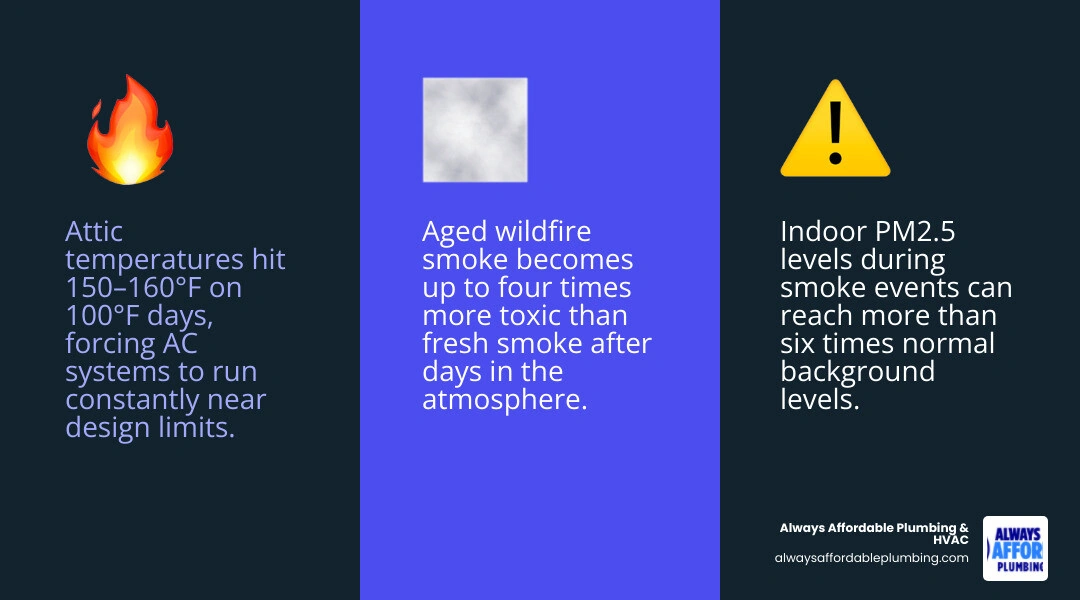
• HVAC system overload - Attic temperatures can reach 150–160°F on a 100°F day, forcing your AC to run constantly near its design limits
• Clogged air filters - Wildfire smoke particles (PM2.5) load filters far faster than normal, restricting airflow and straining blower motors
• Degraded indoor air quality - Indoor PM2.5 levels during smoke events can reach more than six times normal background levels
• Fireplace and plumbing stress - Heat causes seals to dry out, chimney drafting to reverse, and water heaters to work harder
• Compounding health risks - Roughly 8% of respiratory hospitalizations in California are directly linked to the combined effect of extreme heat and wildfire smoke
• Aged smoke toxicity - Smoke that has been in the atmosphere for days can become up to four times more toxic than fresh smoke
Sacramento Valley residents face a uniquely tough combination of factors: an urban heat island effect that adds up to 8°F in downtown Sacramento, Delta Breeze humidity spikes that force HVAC systems to work overtime, and wildfire smoke that can drift in from hundreds of miles away. Summer fire season pollution now accounts for roughly 40% of days exceeding federal PM2.5 standards in the Sacramento Valley — a dramatic increase from less than 10% earlier this century.
Understanding what is happening to your home systems during these events is the first step toward protecting your family and your investment.
Simple guide to how sacramento valley heat and wildfire smoke affect your home:
• how triple digit temperatures stress your ac and plumbing
• how wildfire smoke affects your indoor air quality
When we look at how sacramento valley heat and wildfire smoke affect your home, we have to look at the big picture. These two seasonal giants do not just take turns causing trouble; they work together in a destructive cycle that strains your home's physical structure, indoor air quality, and mechanical systems.
In the Sacramento region—from the older, tree-lined streets of Land Park and East Sacramento to the newer developments in Roseville and Elk Grove—our homes are subjected to a brutal summer climate. The valley floor acts like a giant bowl, trapping heat during our frequent triple-digit stretches. When wildfires spark in the surrounding Sierra Nevada foothills or coastal ranges, wind patterns carry thick plumes of smoke directly into our living spaces.
This combination creates a compounding burden. The intense outdoor heat forces your air conditioning system to run almost continuously to keep indoor spaces safe. At the exact same time, the outdoor air is thick with microscopic ash, soot, and chemical compounds. Your HVAC system must act as both a cooling machine and an air purifier. This dual demand pushes mechanical parts to their absolute limits, which is why we see a dramatic spike in system failures during peak smoke and heat events.
To make matters worse, we must also consider the unique regional behaviors of our climate, such as the Delta Breeze and the urban heat island effect. Understanding these dynamics helps us make smarter decisions about how we run our homes, protect our equipment, and safeguard our health. You can learn more about these regional interactions in our comprehensive guide on How Sacramento Climate Affects Your HVAC and Plumbing.
The human body and a home's mechanical infrastructure react to extreme heat and wildfire smoke in surprisingly similar ways. Both experience severe stress, restricted pathways, and elevated failure rates.
From a health perspective, the statistics are alarming. Roughly 8% of respiratory hospitalizations, 5.5% of cardiovascular cases, and 6.2% of renal (kidney) cases in California are directly attributable to the interaction of extreme heat and wildfire smoke. During the 2020 wildfire season alone, more than 43 million people across the western U.S. were exposed to both ground-level ozone extremes and wildfire PM2.5 (fine particulate matter) in a single day.
When your body is exposed to extreme heat, your cardiovascular system works harder to pump blood to your skin to cool you down. If you are simultaneously breathing in PM2.5—particles so small they bypass your respiratory tract's natural defenses and enter your bloodstream—your heart and lungs are placed under immense double-duty strain.
Structurally, your home faces a parallel crisis. The heat forces the building envelope to expand, opening tiny cracks around windows, doors, and utility penetrations. The particulate-heavy air is then drawn into these openings due to pressure differences. Once inside, this soot settles on your coils, clogs your filters, and coats your living surfaces.
The Sacramento Valley has a highly specific climate profile that dictates how these forces behave. The first major factor is the urban heat island effect. Downtown Sacramento, Citrus Heights, and Rancho Cordova can experience temperatures up to 8°F hotter than surrounding rural areas. This localized heat retention means your AC unit has to fight a much higher baseline temperature, running late into the night when rural systems have already started to cycle off.
The second factor is our beloved Delta Breeze. While this cool, marine air intake from the San Francisco Bay is a welcome relief on hot summer nights, it introduces a massive humidity spike. When high humidity mixes with heavy outdoor dust and wildfire ash, it creates a sticky, paste-like residue. This residue adheres to outdoor condenser coils and indoor evaporator coils, acting as a thermal insulator that prevents proper heat transfer.
Finally, we must address aged smoke toxicity. Wildfire smoke does not remain static as it travels. As smoke drifts from distant fires toward communities like Folsom, El Dorado Hills, or Citrus Heights, it undergoes a chemical transformation called atmospheric oxidation. This process creates nitrous acid and secondary organic aerosols, making the aged smoke up to four times more toxic than the fresh smoke found at the active burn site. This highly toxic, fine particulate matter easily penetrates older home envelopes, creating a severe indoor health hazard. You can monitor these localized shifts and understand their direct impacts by staying updated on Folsom Air Quality.
When triple-digit heat waves and thick wildfire smoke blanket the valley, your home's mechanical systems bear the brunt of the physical strain. Think of your HVAC system as the lungs of your home. Under normal conditions, it breathes easily, cycling air through filters to keep things comfortable. But when the air is thick with ash and the temperature is soaring, your system has to work twice as hard just to achieve basic cooling.
The primary point of failure during these events is often the air filter. As wildfire smoke deposits millions of microscopic PM2.5 particles into your ductwork, the filter rapidly fills up. A clogged filter creates high static pressure within the system, forcing the blower motor to work significantly harder to push air. This restriction can cause the evaporator coils to freeze over, completely shutting down your cooling. To understand the mechanics of this issue, read our detailed article on How Clogged Air Filters Damage AC.
Most residential air conditioning systems in areas like Woodland, Davis, and Sacramento are designed around a standard 20-degree rule. This means that under optimal conditions, a properly sized and maintained AC system is engineered to lower the indoor temperature by a maximum of 20 degrees compared to the outdoor air. When outdoor temperatures hit 105°F, your system is working at its absolute limit to keep your indoor spaces at 85°F, let alone a comfortable 78°F.
When you add wildfire smoke to this thermal load, the efficiency of your system plummets. Outdoor condenser coils, which are responsible for releasing the heat extracted from your home, become coated in fine ash. This ash acts as an insulating blanket, trapping heat inside the coils and forcing the compressor to run at dangerously high pressures.
Your fireplace is another surprising vulnerability during a summer heat and smoke wave. In many older homes across Carmichael and Fair Oaks, gas fireplaces feature standing pilot lights. While small, these pilot lights generate constant ambient heat that your AC must continuously fight to remove.
Additionally, intense summer heat can cause a phenomenon known as chimney drafting reversal. When the air inside your chimney is cooler than the blistering air outside, the draft can reverse, pushing hot, smoky air down the flue and directly into your living spaces.
To combat these vulnerabilities, having sufficient attic insulation is critical. Many older valley homes still rely on outdated R-19 insulation (about 3 to 5 inches thick). Upgrading to R-49 blown-in insulation (10 to 14 inches) acts as a highly effective thermal barrier, keeping attic temperatures—which can reach 150–160°F—from radiating down into your ceiling. Keeping your system tuned up is the best defense against these extreme conditions, as outlined in our guide on the Benefits of Regular HVAC Maintenance in Hot Dry Valley.
While HVAC systems are the most obvious victims of summer weather, your plumbing system also experiences significant stress. The Sacramento Valley is known for having hard water, which contains high levels of dissolved minerals like calcium and magnesium.
During prolonged heat waves, municipal water temperatures entering your home are much warmer than they are in the winter. This warmer baseline temperature, combined with high household water demand, accelerates the rate at which mineral scale precipitates out of the water and settles at the bottom of your water heater.
This sediment buildup acts as an insulating barrier between the burner or heating elements and the water itself. As a result, your water heater has to run longer and hotter to heat your water, leading to thermal expansion stress and a higher risk of tank failure.
Additionally, extreme heat can cause the ground to dry out and contract, placing physical stress on buried main water lines and sewer pipes, which can lead to sudden leaks or slab ruptures.
During a major smoke event, your home's building envelope—the physical barrier separating your indoor living space from the outdoor elements—determines how much pollution makes its way inside. Unfortunately, no home is completely airtight.
Research shows that indoor PM2.5 levels during wildfire smoke events can reach a median of 31.5 µg/m³, compared to a typical indoor background level of just 4.7 µg/m³. This represents an indoor-to-outdoor PM2.5 ratio of roughly 0.75, meaning that without active filtration, up to 75% of the outdoor smoke pollution will eventually settle inside your home.
The age of your home plays a massive role in this infiltration. Homes built before 1975 typically have an infiltration factor of 0.41, meaning they allow about 50% more outdoor air and smoke to leak inside compared to post-1975 homes, which average a tighter infiltration factor of 0.27. Common entry points include unsealed window frames, worn door sweeps, fireplace dampers, and attic access hatches. To understand how these particles behave once they cross your threshold, read our article on How Wildfire Smoke Affects Your Indoor Air Quality.
When selecting an air filter to protect your home from wildfire smoke, you must balance filtration efficiency with your system's airflow requirements. Filters are rated using the Minimum Efficiency Reporting Value (MERV) scale, which runs from 1 to 20.
• MERV 1–4 — Smoke Particle Capture Efficiency (PM2.5): Minimal (Does almost nothing for PM2.5) — Airflow Resistance / Static Pressure Risk: Very Low — Best Use Case: Basic dust protection only
• MERV 8 — Smoke Particle Capture Efficiency (PM2.5): Low (Captures large dust/pollen, lets smoke pass) — Airflow Resistance / Static Pressure Risk: Low — Best Use Case: Standard spring/fall conditions
• MERV 13 — Smoke Particle Capture Efficiency (PM2.5): High (Captures over 75% of 0.3–1.0 micron particles) — Airflow Resistance / Static Pressure Risk: Moderate (Safe for most modern systems) — Best Use Case: Recommended for wildfire smoke
• MERV 16 — Smoke Particle Capture Efficiency (PM2.5): Maximum (Captures over 95% of fine particles) — Airflow Resistance / Static Pressure Risk: High (Extreme risk of system damage) — Best Use Case: Only for specialized or modified systems
While a MERV 16 filter offers incredible filtration, installing a standard 1-inch MERV 16 filter in a typical residential slot can severely restrict airflow. This restriction can lead to frozen evaporator coils, high energy bills, and eventual blower motor burnout.
For most homes in the Sacramento region, a MERV 13 filter is the ideal starting point. It offers a high capture rate for fine smoke particles without creating excessive static pressure. To find the perfect match for your specific equipment, consult our guide on the Best Air Filter for Your Home.
For homeowners looking for protection beyond standard filters, there are several advanced indoor air quality (IAQ) options:
• Whole-House Air Purifiers: These systems are integrated directly into your existing HVAC ductwork. They use electronic media, ionization, or photo-hydro-ionization (PHI) to neutralize airborne contaminants, viruses, and smoke odors throughout your entire home.
• True HEPA Filtration: High-Efficiency Particulate Air (HEPA) filters capture 99.97% of particles as small as 0.3 microns. Because they are highly restrictive, they are typically installed as bypass systems or standalone portable units.
• Activated Carbon Filters: Standard filters capture physical particles, but they do not stop toxic gases, volatile organic compounds (VOCs), or smoke odors. Activated carbon filters use chemical adsorption to trap these gaseous pollutants.
• Corsi-Rosenthal Boxes (DIY): If you do not have central air or need immediate extra filtration, you can build a highly effective DIY air cleaner. By taping four MERV 13 filters to the intake sides of a standard 20-inch box fan, you can create a high-volume air purifier that rivals expensive portable units.
• UV Lights: Installing ultraviolet (UV) germicidal lamps inside your HVAC evaporator coil chamber helps prevent mold, bacteria, and organic growth from accumulating on damp surfaces, keeping your system running efficiently.
As you plan these upgrades, it is also helpful to stay informed about industry standards and guidelines, such as those covered in HVAC Regulatory Changes in 2023 What Homeowners Need to Know.
During a severe heat and smoke event, homeowners are often forced to make a difficult choice: should you focus on keeping your home cool, or should you focus on filtering out the toxic air?
When forced to choose, cooling must take precedence over air filtration. If your indoor temperature rises above 81°F, the risk of heat-related illnesses like heat exhaustion or heat stroke increases rapidly, especially for vulnerable populations such as children, the elderly, and those with pre-existing conditions.
• Priority 1 — Goal: Maintain Safe Indoor Temps — Action Steps: Keep indoor temperature below 81°F using AC, fans, and shading. — Why It Matters: Overheating poses an immediate, life-threatening risk.
• Priority 2 — Goal: Restrict Smoke Intake — Action Steps: Set HVAC to Recirculation Mode; seal gaps with painter's tape or damp towels. — Why It Matters: Prevents fresh, toxic outdoor air from entering your living space.
• Priority 3 — Goal: Active Filtration — Action Steps: Run HVAC fan continuously; use portable HEPA purifiers or DIY box fan filters. — Why It Matters: Cleans the air that has already managed to leak inside.
• Priority 4 — Goal: Minimize Indoor Pollution — Action Steps: Avoid cooking with gas/grease, vacuuming, burning candles, or using exhaust fans. — Why It Matters: Keeps you from adding self-generated pollutants to the indoor air.
By managing your system strategically, you can achieve both safe temperatures and clean air. Upgrading to a modern, efficient system can make this balance much easier to maintain, as discussed in New HVAC Benefits Beyond Comfort.
To stay safe and comfortable when it is both hot and smoky outside, we recommend implementing these practical home management strategies:
1. Utilize Recirculation Mode: Ensure your thermostat is set to "Recirculate" or "On" rather than "Auto." This keeps your system's fan running continuously to filter the air, and it closes any fresh-air intakes that would otherwise pull toxic outdoor smoke inside.
2. Create a Designated "Clean Room": Choose a central room in your home—ideally one with minimal windows and doors, like a master bedroom. Seal any visible gaps around the doors and windows with painter's tape or damp towels, and run a portable HEPA air purifier continuously in this space.
3. Pre-Cool Your Home: Run your air conditioner at a lower temperature during the cooler morning hours. This "thermal storage" helps keep your home cooler during the peak heat of the afternoon, reducing the strain on your system when electricity demand is highest.
4. Wear an N95 Mask Indoors If Necessary: If your home does not have air conditioning and indoor temperatures exceed 81°F, you may need to open your windows at night to cool the house down, even if it is smoky outside. In this scenario, wear a well-fitted, NIOSH-certified N95 respirator mask indoors to protect your lungs while you cool the home.
Staying informed is your best defense during wildfire season. We recommend downloading the EPA AirNow App and the Sacramento Region Air Quality App to monitor real-time Air Quality Index (AQI) levels and track drifting smoke plumes.
You must prioritize cooling. If your home does not have functional air conditioning and indoor temperatures begin to exceed 81°F, you should not keep your windows sealed to block smoke. Instead, open your windows during the cooler night hours to lower the indoor temperature, and wear an N95 mask indoors to protect your respiratory system.
During the hottest parts of the day, seek shelter at a designated local cooling center, a public library, or a shopping center with active air conditioning. Stay well-hydrated by drinking plenty of water and electrolyte-rich beverages to protect your kidneys from heat stress.
Under normal conditions, we recommend replacing your HVAC filter every 90 days. However, during an active wildfire smoke event, you should check your filter every 30 days.
If you are experiencing heavy, nearby smoke, you may need to replace your filter every 1 to 2 weeks. If the filter medium looks grey, dark, or covered in soot, it is fully loaded and restricting airflow. Replacing it promptly prevents system strain and keeps your indoor air clean.
Keep an ear and an eye out for these common warning signs of system failure:
• Ice Formation: If you notice ice building up on the copper refrigerant lines or on the outdoor unit, your airflow is severely restricted, likely due to a clogged filter or a failing blower motor.
• Tripped Breakers: If your AC unit repeatedly trips your electrical breaker, the compressor is drawing too much current, indicating electrical strain or mechanical failure.
• Continuous Running: If your system runs non-stop without ever reaching your thermostat's set temperature, it is struggling to transfer heat, which could be caused by dirty coils or low refrigerant.
• Unusual Noises: Squealing, grinding, or loud banging noises from your indoor or outdoor unit indicate worn bearings, a failing motor, or loose components that require immediate professional attention.
Protecting your home from the combined forces of extreme valley heat and toxic wildfire smoke requires a proactive approach. By understanding how these environmental factors interact with your home's mechanical systems, you can take practical steps to safeguard your equipment, improve your indoor air quality, and keep your family safe.
At Always Affordable Plumbing & HVAC, we are proud to serve communities throughout the Sacramento region, including Sacramento, Elk Grove, Roseville, Folsom, Citrus Heights, Davis, Carmichael, and the surrounding areas. Whether you need an emergency AC repair, a whole-house air filtration upgrade, or a comprehensive plumbing inspection, our licensed technicians are here to provide quality, transparent, and affordable service.
Don't wait for the next heat wave or smoke event to catch you unprepared. Protect your home with Always Affordable Plumbing & HVAC and ask about our Member's Club for year-round discounts and priority scheduling.
See what our satisfied customers have to say about their experience with Always Affordable
Plumbing & HVAC.

"Chappy was very skilled in his knowledge of my HVAC unit. I greatly appreciate the quick response and experienced tech. The whole endeavor was made less stressful by his humor and honest conversation. I find comfort in knowing I now have a shop i trust for the next time."
"Tony, James, Ronnie did an amazing job setting up our new AC! They were quick, efficient, considerate, and polite! We appreciate them scheduling us in on such short notice. Definitely recommend this company!"
"Prompt, professional service with kindness and care. They came out to address both plumbing and AC issues. I received a courtesy call before they arrived. All issues were resolved the same day with integrity and respect. Thankful for businesses like this. Absolutely recommend to those that I love."
"Excellent service! Jason came out promptly and in addition to doing my outside faucet he also put in new irrigation equipment! All done perfectly! Jason was lovely"
"Honest with the assessment; friendly and good manners. No high pressure sales. Just good to honest "tell it like you see it" Thought my kitchen disposer needed an overhaul. But Jason, there Plumber gave me an honest lesson on what was really happening. Saved me hundreds, if I went the route of replacing. Thank you!"
"Absolutely 5 stars. If you are looking for affordable ,professional and kind. Chappy was excellent and very knowledgeable . I called in the morning because my air conditioner stopped working he was here within hours and fixed my air with a smile. I highly recommend Chappy and Always Affordable plumbing and Hvac."
"Scott and James were great. They got there quickly and diagnosed the problem with my A/C.They did a very thorough job testing everything. Sent me pictures and called to keep me informed. Got it done the next day and everything is working fine. Be glad when I get home so I can enjoy my new system. Thanks guys for a great job."
"Chappy was very helpful. He knew our issue right away, cleaned our coils. He also came on the same day we called and got our AC blowing cold air again."
"After some timing ’curfuffles’ the Tech Jason arrived and not only completed a speedy install on my toilet, he was personable & professional. Because of the timing issues Jason was attentive and showed up with everything needed! No extra store runs 😊 I was very comfortable with having this Tech in my Daughter’s home. We will definitely use this Service again."